Monday, June 04, 2007

Post-Postopolis! Blues


[Image: The Postopolis! crew: (l-r) Joseph Grima, Jill Fehrenbacher, Geoff Manaugh, Bryan Finoki, Dan Hill, and Gaia Cambiaggi (photo by Nicola Twilley)]

So, I’ve finally awoken. I think this is the first time I have done so in the last week. And I am no longer in New York City, in that killer studio on the upper west side, or in the truly bunker-esque subtopian gallery space that is the Storefront. No, I am no longer in that place we called Postopolis! for one full week, seven surreal days now that will surely slip further into the precious realm of future daydreams as I sit here at my little tabletop in San Francisco again, an all too familiar chunk of space, and try to make sense of it all, try to reassure myself that I was actually in New York City for the first time, that it was really me standing in front of a bunch of people embarrassingly babbling my incoherent head off about border fences and floating prisons, that it was actually me meeting some of the coolest people I have ever met in my entire life, putting faces to words, matching web monikers and emoticons to physically tangible smiles and the sounds of chuckles that poured out from behind them, while trading beers for business cards and wiping the sweat off my brow, forgetting to eat lunch almost daily for being so ridiculously engaged in what has to be one of the coolest weeks ever in the crazy times of Bryan Finoki’s rambling silly little ongoing world of worlds.


[Yours truly rambling through pseudo-captions to wacky collection of images at a million miles an hour hoping I could go fast enough so that no one would notice I might not actually be making any sense. Postopolis!: Pecha Kucha: Subtopia, Photo by Joseph Grima.]

Like my partners in crime in all of this I am incredibly torn suddenly being back home. It’s over. Like a line in a cheesy melodramatic soap opera break up, "It’s over." In fact, I didn’t want to come back home at all, but was hoping that Sunday was merely a break in between the action and that come Monday Postopolis! would some how resume its normal programming, and that without a hitch (aside from the normal resident and truly charismatic hitches that go with the territory) that the show would go on! On one hand, my energy tank has been so simultaneously drained and re-filled again as a result of the whole thing that I am incredibly sad it has come to an end, but am also feeling like I might in some obnoxiously hippie kind of way be ready to in fact take over the world as a result of it.
Now I don’t want to get weird and sentimental about this, but seriously – this was one of the best times of my life. I know, crazy! And I can’t even express that enough. Not nearly. For all the talk about blogs and their effect on conversation (real life or otherwise), this measly blog post right here forming under my jittery fingertips seems ironically and indefinitely inadequate right now to describe just what an amazing time I had.


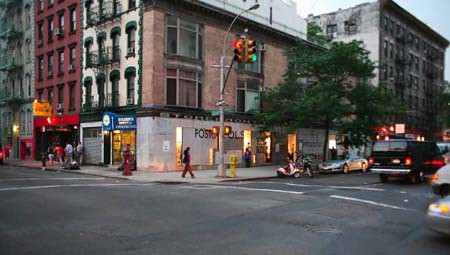
[Image: The facade of the Storefront. Photo by Bryan Finoki.]

I will, of course, be relaying in a fractured narrative of some sort over the next couple of weeks, maybe even month, much of what transpired from some subtopian angle of sorts, but for now, there is much personal stuff to say and get off my chest.
So, first. Thanks to all who made it out to the event and helped make it what it was. I think we are all feeling thunked over the head by just how damn fun, engaging, diverse and expansive it was, just how planned and yet perfectly accidental it was. I hope all you who attended and participated thought that it was a giant success, too.


[Image: Photo by Dan Hill.]

And (without turning this into a mock award speech of thank you’s and I’d just like to say, kind of a thing), I do just want to say – it was truly incredible meeting everyone. From those nutty blogger partners of mine (Geoff, Jill, and Dan) who were ballsy enough to work with my crazy hyper-enthusiastic ass, to all the speakers we invited who were some how as excited as we were to participate in this thing, to the whole Archinect crew (John, Susan, Quilian, Aaron, Enrique, Larslarson, Futureboy, Marc), to all the bloggers who also came out to play [Miss Representation, Enrique Gualberto Ramirez (aggregat456), George Agnew (Architecture of Fear), Chad Smith (Tropolism), Abe Burmeister (Abstract Dynamics), John Hill (Archidose), Ryan McClain (Architecture.MNP), Alec Appelbaum (NY Magazine), Quilian Rilano (GSD School Blog)], to all the long time friends I had not seen for years who suddenly showed up to see me squirming like an anxious freak in front of people pretending to be savvy, all the way to the all those random New Yorkers in the street who watched and laughed at me as I obviously fell in love with their bad-ass city before their eyes and who was unable to stop himself from expressing it to them in drunken fits of Bfunk passion.


[Image: The Archinect crew on a panel discussion. From top to bottom: Aaron, Enrique, Susan, John, Quilian. Photo by Bryan Finoki]

Seriously, I’ve never participated in anything like that before, and -- talking about a convergence of things -- I could not have imagined that so many elements would have come together the way they did, or the sheer firing on all cylinders that took place like that in order to some how engineer Postopolis!. I think I slept one night last week and made more genuine connections with people in that time (that I will definitely follow up and collaborate with in the future) than I have in the last two years here in San Francisco. Oh New York! Oh Postopolis! where for art thou!


[Image: Geoff conducts a live telephone interview with Mark Wigley on blogs and architectural discourse for all to hear at the Storefront.]

I know you were probably expecting me to blog like a madman about the whole thing so I am sorry if I let you down in that regard. But, I think the real value has been in somehow bridging the virtual world of bloggerdom with an actual node in physical space where people could come together out from behind their anonymous virtual identities and just talk, and listen, and smell each other and raise a glass to some shared idea and space in the sultry New York heat.
(And I’m also sorry if this is turning into one of those annoying super-personal self-indulgent awfully narcissistic diary-like blog entries, but this was truly one of the best times of my life! For other special reasons, too – I mean, I was completely overwhelmed by my romance with the city, with ideas, with future possibilities, with a beautiful woman even!! It was one crazy-ass bubbling over of good times that now seems crammed into my head like an overstuffed archive, or a frozen filmic spree of snapshots and random emotional imprints that I can’t seem to verify as actually having registered in real time.)
Ok. I promise - I will try to move on.


[Image: Jill leads a discussion panel on sustainabile design with Susan Szenasy, Graham Hill, Allan Chochinov.]

Now it seems like a shame to not consider what should become of it next. We have talked some about it already and have gotten enough response from everyone who was there that Postopolis! should indeed turn into a regular event of some kind. Whether replicated yearly in New York or as a migrating event around the world, the sense that Postopolis! could and should become a kind of place, a permanent space, a hybrid little city of ideas and exchange within itself, part café by day, part bar by night, frothing like an intellectual arcade through out the day – I think that would be so fucking cool! Postopolis! ongoing, traveling, unending, unfolding, widening the range of architectural topics, a ceaseless conversation about all things spatial. That just never stops!


[Image: Joseph Grima, the man behind the Storefront enjoys a little suds action.]

Of course, before we get carried away, there is the biggest thank you of all that I owe, and that is to Joseph Grima and the entire crew at Storefront (Camilla and Jess and all the others – forgive me if I forgot your names!). It was a brilliant juggling act of seat-of-your-pants tinkering with gears and machinery and tangles of cords and on-the-fly puppet master artistry. Joseph worked the place like the transparent behind-the-scenes inner workings of a street side magic show, climbing ladders twirling knobs, tending to this informal architectural animal that he somehow managed to tame in order to convert the Storefront into an absolutely perfect Postopolis!-defining space. And, in the end, I can’t really see this event being initiated anywhere else.
So Joseph – dude, man….I can’t tell you how awesome and inspiring this has been, and how truly excellent it was to collaborate like that. As you say, “this is just the beginning”, and well – needless to say, that was one helluva start.

Some initial Postopolis! Coverage with an Ode To Dan Hill – The “He-Man Stenographer of Postopolis!"

So, like I said, I will be posting bits and pieces of what really stood out for Subtopes in the near future, as I know the others will, too, but in case you are looking for some coverage right away let me offer a few quick sources.


[Image: Dan Hill, A blogger on a rampage at Postopolis! Photo by Bryan Finoki]

First and foremost, let me point you to Dan’s own brilliant coverage, in case you haven’t come across it yet. The man was incredible, sitting there in front of the whole show, with his laptop propped up on a little fold out chair, his fingers working quadruple time, each with a mind of its own, coordinated finger sculptures that pressed down on short cuts and keyboard commands like pieces of handmade architecture, nomadic over sprees of lettering. I have never seen anyone like that listen so intently to the speakers, getting it all down in the computer, interpreting, editing, adding images, pulling links, moving text all around, breaking to ask questions, resuming some display of stenography that has surely evolved the science of blogging. Just check out City of Sound. The entire event blogged in real time. I called him the “He-Man of Postopolis!”. It was incredible. I was blown away. That dude simply has an intellectual eye-and-hand coordination I will never possess.
There is also a great collection of YouTube videos of most of the presentations on the Storefront website, that are really excellent. We tried to record everything so it could be archived in some way and we are still working out how we might add to this in the future. There are only ten minutes worth of each presentation online but still they give you a good insight into what and how it all went down.


[Image: The closing party on Saturday night of Postopolis! June 2, 2007. Photo by Bryan Finoki.]

Then there is this great thread on Archinect. A piecemeal collection of random thoughts, snippets, reflections, postings by editors Aaron Plewke, Quilian Riano, some sweet pics by Susan Surface, and random extracts by many other observers.
In case you need more pictures, we started a Flickr pool here, which has some great collections of shots and scenes as it unfolded.
So, take a look.
Of course, watch BLDGBLOG and Inhabitat for future stuff, too. But that should hold your curiosity in the meantime.


[Image: While this is only a rendering for the proposed facade at the Storefront, and not an original photo, it still shows you pretty much the way it looked. With that, I leave us to imagine the future space of the next Postopolis! Image by Joseph Grima. Click here for a larger version.]

So, with all of that finally said, I also just need to say thanks to everyone again: Geoff, your energy for all of this was truly inspiring, I found myself just trying to keep up at times. Jill, so cool to finally meet, but honestly I can’t think of any better circumstance for doing so. Dan, like I said, you’re the man.
Now all that is left to say I think is - let’s do it again!

Tuesday, April 07, 2009

An Ode to the Anonymous Audience of Postopolis!


[Image: Standard Hotel Rooftop, LA. Photo by Bryan Finoki.]

Well, Postopolis! is over now and this is the time I go through a little withdrawal, wishing that in just a couple of hours I’d be heading back up to the plastic paradise of the Standard Hotel’s decadent rooftop to meet my fellow cohorts and mush my little heap down into a lawn sofa somewhere around the plasma screen and projector, having forgotten to eat an early dinner once again beforehand, but still eager to plug my head back into another round of provocative presentations. Ahhh…what a week we just had.

First order of business: Thanks to all who made it out there and braved the cold with us (that climate was not what any of us expected), and to those of you who introduced yourself. It was great to meet and talk beyond the comments section of this blog, and your compliments and feedback were most appreciated and inspiring. So thanks again! Overall, the turnout was great, from the first presentation to the last panel discussion – thanks to you and all the presenters we had an amazing time.


[Image: Joseph Grima. Photo by Dan Hill.]

Next, I want to say thanks again to Joseph, director of the Storefront, for pulling it all together once again. He’s an absolute magician, among other things, and with the nimble hands of César, Jose and Faris, the production was another masterful act of quick string-pulling and delicate tape jobs, an artform in urban network hacking, running cables down the side of the building, steadying multiple video cameras before they actually fried in the winds, massaging temperamental mics, it was all a classic juggling act of unexpected actions and reactions, frenetic tweaks and clever finesse moves – it was another successful ad hoc postopolisian mission. Thanks dudes!


[Image: Standard Hotel Rooftop, LA. Photo by Storefront for Art and Architecture.]

And of course, a huge thanks to Bettina and her entire crew of For Your Art who really helped bring Postopolis! to its mantle there at the Standard and treated us all like rockstars! (that's a serious rarity for this guy) – your constant attention and energy was greatly felt, and I can’t show my appreciation enough.

So, more of my notes, reflections, and thoughts over what actually came out of Postopolis! this time around will infiltrate my regular postings in the future, but for now I can’t help but to wring a bit of juice out from my sodden brain that’s still a bit cramped from all the computing I tried to do in that 30 or so hours of listening and engaging with everyone who showed up last week with their range of perspectives. Just to be a listener for that long was enough to test the concentrated fortitude of even the most focused minds, I think. For me, it was akin (I imagine) to having an entire hard drive downloaded into my brain filling it up with applications I’ve never used before, files I’m still trying to figure out how to open – a mini encyclopedia of space-related projects inserted behind my lobes that will take some time to figure out how to truly discern and wield their power; Postopolis!, in my experience, is like a form of Matrix-style cyborgian learning (no external jack required). I’m a little drained.


[Image: Dan Hill (The He-Man stenographer of Postopolis!) in action. Photo by Storefront for Art and Architecture.]

I still have no idea how Dan is able to not only take it all in but to get it down on paper and then magnify it with his own rich observations; or how Geoff (who largely twittered the entire thing!) was able to balance his listening powers with his writerly fingertips while also keeping his own questions freshly formatted in tact on the forefront of his brain. I just don’t have that partition-ability, I suppose. I guess I aint no Neo for the next millennium. Sorry, Dennis (as much as I would like to be, I’m hardly the genius you think I am).


[Image: Standard Hotel Rooftop, LA. Photo by Storefront for Art and Architecture.]

Anyway, the rooftop was simply divine and I'm having trouble being a way from it now, despite the fact it was a little early in the year to take full advantage of, meaning that each night was laced with near limb-crippling winds that almost froze the most important parts of our bodies off; in such conditions you could have easily tested some serious design in airborne architecture up there. But, with bedspreads from rooms pulled up to some peoples' necks, and constant drizzles of wine and vodka, or for me a sweet-ass little sweater I picked up from a vendor for ten bucks, we all survived.

The other aspect of the rooftop which was wild in such a perfeclty LA strutted sort of way was how completely different each side of the space was, culturally: there was the Postopolis! crew, a dense mingling of spatial-heads of sorts freezing on the Astroturf on one side, and then there was this whole other funky LA wing that got to hang out under the immoveable heat lamps on the other, from midday business types, to blingy G'd-out wannabe thug-types, to over-perfumed short skirts and gold necklaces slung around macho necks, excessive gelled-hair, assorted bicep landscapes, and some very obnoxious partiers in leopard spotted tank tops who stumbled and spilled their drinks all over you rather than get them down even remotely close to their chins. But, without being too critical, we were vastly two different worlds up there and it was all part of the little urban island we had managed to create. Of course, I miss every bit of it now, hotel drunkards and all.


[Image: Standard Hotel Rooftop, LA. Photo by Dan Hill.]

And it goes without saying, it wouldn’t be Postopolis! if the environment itself didn’t somehow have a huge say in our experience – it’s part of the concept, right? Tough to talk about cities, space, and place with any seriousness if you can't reflect on the immediate context itself, maybe even better perhaps when by force.

The first time in New York, the Storefront in May -- even with its perforated walls -- was practically a confection oven. While various sirens and truck engines grumbled past the gallery in a constant flow of heavy mechanized sound-objects, rattling the gallery’s foundation to the core while also vying for supremacy over or own noise output, the walls and everything they surrounded dripped in buckets of sweat. The Storefront in this sense literally gave its own presentation for Postopolis! – as if the gallery was the quiet keynote speaker of the whole thing; and for its grand finale (as you may or may not recall) the ceiling actually crumbled with tiny pieces that fell onto the head of Jeff Byles as he very appropriately read a chapter from his book Rubble: Unearthing the History of Demolition.

It was perfect, and there was that same sort of serendipity here, too. Only this time the white noise of Manhattan’s dense auto congestion was replaced by a constant swarming of LA's helicopters that cut through the narrow airspaces over our heads like mutant urban insects, while the Standard’s resident dj’s on the other side of the rooftop seemed to beckon them with cliché dance floor tracks, not to mention some hilariously timed wafts of dope smoke that blanketed our haven one night from a pool party around the corner (or from somewhere), or the occasional misfirings in amplitude of the speakers – it was all a quintessentially environmental experience. And the Standard itself was the headline.

And, much like Byles' experience, on Saturday, while Christian Moeller (invited by Regine Debatty, author of -- still to this day -- the coolest blog out there - we-make-money-not-art) was presenting his work, which combines art and in some cases large scale robotics (one project of which was designed to use vibrations in order to communicate through the user’s body directly) and, after he'd just told the audience he “had a fascination for technical fuck-ups”, the strangest thing kept happening: every time he would go to touch his laptop to forward the next slide of his presentation he would receive a crazy shock! It was hilarious, you could actually hear it, and bizarrely timed, since we hadn’t seen anyone else get shocked like that. And it kept happening! And I think he actually got a perverse thrill out of it! It was crazy.


[Image: Standard Hotel Rooftop, LA. Photo by Dan Hill.]

Anyway, Dan described the rooftop scenario quite well when he alluded to it becoming a sort of nocturnal nest that by night drew the buildings around us in closer with all the lights that came on after dark, 'like a canopy', he said; an intimacy with downtown architecture that could only exist between the time the sun went down and came back up again. It did have this feeling that Postopolis! sort of invited the buildings onto the tips of their chairs around us to have a closer gander too, as if our little series of talks was too interesting even for them not to take notice; as if they knew this had everything to do with them in some sense, and so (despite their immobility) even their curiosity could not be contained or left unevident. In spite of the chill factor, this closeness to the buildings was quite warming I thought, and at times I felt like Postopolis! was as much for the surroundings themselves as they were for anyone else. The towers around us created a kind of peripheral fireplace (though certainly emitted more by light than heat), and gave off a coziness that kind of sealed Postopolis! in its own world, in a way.


[Image: Standard Hotel Rooftop, LA. Photo by Dan Hill.]

This vantage led Geoff to imagine a cool series of lectures one might give from the Standard’s rooftop referencing the surrounding buildings in a way they’re not often talked about; to point out, for example, a stratified history about their many lesser known significances and meanings; to create a “narrative planetarium”, he says, whereby stories about certain rooms, or archways all around the rooftop, or the secrets of other nearby rooftops, etc., could be revealed, as if the buildings around us were a library of mysterious histories that seemed to stare at us from every angle and in a way beg to be revealed. (G, that would be amazing, when you get down there you and Matt should make something like that happen!)


[Image: Standard Hotel Rooftop, LA. Photo by Dan Hill.]

I kind of imagined Postopolis! as having the opposite effect, in the sense that we had drawn the attention of the buildings our way. Once the sun fell and all the lights popped on inside a thousand high rise windows around us, I got the feeling that our little show had become a kind of welcomed distraction for all those who remained trapped in their cubicles on those nights, filed away on the 22nd floor behind their desks, stuck doing overtime behind all that steel and glass, or finishing up some useless report, who just craved distraction out of the corners of their eyes. I’d like to think that our projections on the hotel’s wall was watched by more than just us, and all those building lights that piled in over our shoulders in a way represented some anonymous audience, who might have been watching it from their office windows; or, perhaps those lit windows floating in the dark in a stretched and fragmented checkered pattern represented an informal mapping of the online attendants who were watching the live stream on the Storefront website, their visibility blipping on and off. The building lights as visualization of our virtual audience.


[Image: Standard Hotel Rooftop, LA. Photo by Dan Hill.]

It’s ridiculous, I know, but what if a janitor inside a building across the street discovered a new hyper-efficient way for vacuuming the office-scape of a thousand cubicles just because he found himself taking a much needed break for a moment to glance at the amazing mapping work of Stamen Design; or, a security guard got re-inspired to tinker with his passion for engineering because he stopped while making his nightly rounds to glimpse the curious robotics that were crawling in place on the side of the hotel across the street...


[Image: Standard Hotel Rooftop, LA. Photo by Dan Hill.]

... what if another person was so engaged by Ted Kane’s documentation of cell phone towers disguised as palm trees they actually forgot to go home for an extra hour!?; beyond casual respite, what if Postopolis! prevented a crime of some sort, distracted a burglar, or caused an insider trader who was too entranced by Matt Coolidge’s incredible video of the Texas oilscape to pay close enough attention to the privileged numbers he’d received in time to place a lucrative sell order overseas? Secret affairs between bank managers and their secretaries on upper floors had not taken place one night because they were simply too enthralled with the sexy sarcastic images of C-Lab.

Absurd, I know, but I like the idea of the presentations having a little unknown effect this way, leaving a hidden mark on the city around us. I imagine a financier sitting atop his own opulent nest late night peering through a telescope down at our affair and coming to a realization about the possibilities for far more interesting projects he could be spending his millions on. (In case you are reading, Mr. Gecko, we are open to receiving donations for our next show.)


[Image: Standard Hotel Rooftop, LA. Photo by Dan Hill.]

And even though many of the onlookers from such anonymous spaces could not hear anything that was being said to them (or maybe they could, our projected audio was actually really good), I wonder about the prospect of the visuals alone leaving a vague imprint that might lead to other intangible actions later on. Or, if all it provided was a little late night eye candy for those sorry enough to still be working that late, then that’s excellent too.


[Image: Standard Hotel Rooftop, LA. Photo by Dan Hill.]

But, what if the buildings themselves took note in some way, as if Postopolis!’ images were a kind of ritual seance that conjured a series of architectural dreams to the city’s surface, a collective unconsciousness that all buildings could identify with, and that we tickled LA’s downtown urbanism in a silly psycho-architectural sort of way, with notions of what things still could be, gave the old school bank towers and corporate HQ structures at the very least a bit of constructive entertainment, something to chew on for a few nights when buildings dream – something new to stare at. As if we had turned the Standard into an architectural crystal ball, though, hardly pretending to pitch any future. Just little hints at possibility. OK, I’m getting carried away, but - call me crazy, I’d like to think our little show brought those buildings to life in some way last week. It sure felt like they brought us to life, like there was a crazy feedback loop of some kind at work there. All of which, I guess, is really just a long long way of saying: it was a great spot. More soon enough.

Thursday, February 05, 2009

The Return of POSTOPOLIS!


[Image: POSTOPOLIS! LA. Logo, thanks to Joe Alterio, 2009.]

It’s been a year and a half since I made this announcement the first time around, and I’m just as excited if not more so to make it again right now. POSTOPOLIS! is back!!!

This time, the crazy weeklong arcade of conversation (around all things ‘spatial’) will weave its way through another hyper-caffeinated babble-scape of tangential architectural detour out here on the Left Coast.

Awwwww yeaaahhhhh….headed to that other bombastic city everyone loves to hate so much, or hates to love, or secretly loves but outspokenly hates! or, wherever you stand – pure love, pure hate, we’re headed there to help! – yup, POSTOPOLIS! will soon be sinking its chatty tentacles deep into the bowels of Los Angeles, a city of the past and the future; a city (which has surely become a city now) of perpetual destruction and simulation; more than just ‘a collection of suburbs in search of a city,’ it’s a giant sleeping ogre laid flat over the arid desert plain where Frank Lloyd Wright once said, “Tip the world over on its side and everything loose will land in Los Angeles.”
Ha. It’s LA! And it’s definitely ever-sprawling, it certainly attracts a strange bunch, it's hungry and so best to gather yourself now and get ready to roll!

Real quick: For those who don’t know what I’m talking about, POSTOPOLIS! was a event fellow bloggers [Geoff Manaugh (BLDGBLOG), Dan Hill (City of Sound), Jill Fehrenbacher (Inhabitat)] and myself, alongside Joseph Grima, the director of the Storefront for Art and Architecture gallery in New York City where we organized and held it back in ‘07. The idea was to examine blogging’s impact on the greater architectural discussion at large that is had in academia and design studios, the media, through professionals, critics and books, etc., and to generally bring people from assorted ‘spatially curious’ perspectives to share their thoughts on space production and reflection to help make evident a wider spectrum of what can actually constitute architectural discourse – basically, architecture blogs as a means for de-limiting the scope traditional discourse. We carried on for 5 marathonic days and had an amazing time meeting people at the Storefront, catching up with everyone from Lebbeus Woods to Tom Vanderbilt, Lawrence Weschler and Robert Neuwirth, just name a few. You can read up on it all here, and here if really want to see what you missed – Dan did an unbelievably superior job of covering the entire thing at City of Sound.

However, the LA line up is a little different – we will miss Jill and her great effort pulling together a green perspective, but in addition to Geoff (SF), Dan (Sidney, Aus.) and myself (SF), David Basulto from the popular ArchDaily & Plataforma Arquitectura will join us from Chile, as will Jace Clayton, a New York City-based musical globetrotter and writer, who is also a dj ambassador of hybrid culture (he pens Mudd Up! and attended POSTOPOLIS! back in NYC); and, last but not least, the ever-inspiring omniscient voice of the blogosphere-meets-art world Régine Debatty from We-Make-Money-Not-Art, who claims to operate from Europe but is obviously more ‘everywhere’ than the rest of us. It’s gonna be good – real good.

While Joseph and The Storefront for Art and Architecture from NYC is still the main man behind the scenes, a lot of this is being made possible by the great efforts of the folks at ForYourArt who are helping immensely to put POSTOPOLIS! LA together as part of the upcoming LA Art Weekend held between April 2-5. ForYourArt was founded by Bettina Korek in ‘07, whose mission is to serve as “an interdisciplinary producer, meta-curator and publisher that creates fresh initiatives by inviting cultural patrons to participate in creative civic engagement.” They’re being great, so let me make a huge shout out of a Thank You to Bettina and her crew for all their generosity and help.

So, heading to LA, these classically referenced highway knots seem pretty appropriate here as a metaphor for all the chatter that’s going to go on come March 31st and through April 4th, with winding onramps and offramps of artists, musicians, and scientists leading us down completely different paths of inquiry, inadvertently towards little hidden rhythms and dimensions of conceptual overlap, making hectic turns into slide presentations between speakers, periodic traffic jams in scheduling (comes with the territory, right?), yet with unexpected appearances and sites of fascination popping up along the way, not to mention all those other anxiously interesting moments in between just listening and learning about different angles of the city, and trying to come up with something different to add to conversation – fueled by the overall thrill of movement! LA Movement. Of meeting people in the great feedback loop that is the culture of the city.

Forgive my effusiveness, but POSTOPOLIS! (for those unable to attend last time) is kind of a run-on sequence of discussions moving one after the other in every direction for five days, sort of like a crazy cerebral roadtrip, a cable car chain of talks, quickfire presentations – you show up, you hang out, you listen, leave, come back, dredge your ears in something new, kind of like an arcade for architectural discussion – though not entirely architectural. It blew my mind last time simply with all the interesting people who showed up to make it what it was. So I hope I have thoroughly convinced all you LAish based readers out there to come check it out at the end of March.

It’s all about hanging out and discovering new work, taking the city apart, finding some new facet, or – just as good – someone else’s own take on the city, just constantly moving on through aboard this Baudrillardian-like tramway of holographic thought and reflection on space, place. It’s like a being a tourist of other people’s passions here in the city, but getting to engage the attractions as opposed to just gazing at them. LA should make it deliciously surreal.

But, that’s just me in my own head during a weeklong deluge of intimidatingly provocative conversation, interview, public dialogue, screen shows, films, readings, panels, poetry, urban guiding – there’s always some surprise, too. Needless to say, it’s going to be ridiculously fun again and you shouldn’t plan on missing it.

Certainly, several cities are ripe for this, but LA is just such a colossus of urban weirdness, odd vanguard, strange overindulgences, pockets of intrigue, plastic fused with concrete, the smell of oranges and gasoline, palms and taillights. It’s a neon oasis siphoning ungodly amounts of water to survive while fires rage along the sides of highways. There’s Hollywood – the capital of global entertainment; Skid Row – the capital of the nation’s homeless population; you’ve got some of the largest segregations of poverty and class war in any city in the world, blanketed by inescapable smog that blows off the coast where wax museum-like narcissism basks on the beaches; there’s the constant tremor of earthquakes and astounding earthquake simulations at work there; the Mexican border’s only 135 miles south, those seismic and political faultlines teased by bizarre porn manufacturing districts, old historic transit tunnels, buried speakeasies and mofioso vaults, the dreamlanes of future superstars and their great grandmothers; there’s psychotherapeutic sheisters and reflexology masseuses for everyone! It’s a car’s world and an urban fortress, a “carceral city” as Mike Davis has put it, a city of insidious barricades, micro prisons, domestic militarization, not to mention the birthplace of inimitable LA pseudo mystics and the country’s biggest SWAT team! What a cocktail. You’ve got Beverly Hills and, essentially, everything else, dog wshiperers, surveillance choppers, 18 year-old self-made millionaire real estate agents, land use wars on taco trucks, reality TV wannabes and the Laker girls! What’s not to like?

Yeah yeah yeah, and there’s plenty of quality architecture, and tons of art – and despite what many may think they know about LA (and I don’t profess to know LA inside out myself at all), it’s got loads of real culture, too.
And we’re hoping to dive in deep. And for all you Socal heads out there to get your scuba gear ready.

Actually, there are a bunch of amazing projects I hope to touch upon there. I can’t wait! However, if reading this, you know of some incredible LA based project, or person, or group, org, something that you think Subtopia simply could not bare to miss, or should speak to, please – add it to the comments, or shoot me an email (subtopia dot blog at google mail). Would love to hear of anything in LA relevant to our little blog here. Please!

But, that’s the initial announcement! More to follow, obviously, as it all comes together. For now, mark this in your calendars:

POSTOPOLIS! LA

A live 5-day blogathon of back-to-back discussions, interviews, panel talks,
slideshows, films and parties with scheduled and unscheduled guests, themed
around landscape and the built environment.

Tuesday, 31 March—Saturday, 4 April, 2009 (LA Art Weekend) 5pm—11pm daily
Brought to you by Storefront for Art and Architecture and ForYourArt.

Hosting Blogs:

Geoff Manaugh / BLDGBLOG (San Francisco, USA)
Dan Hill / City of Sound (Sidney, Aus.)
Bryan Finoki / Subtopia (San Francisco, USA)
Régine Debatty / We-Make-Money-Not-Art (Paris, France)
Jace Clayton / Mudd Up! (New York, USA)
David Basulto ArchDaily & Plataforma Arquitectura (Santiago, Chile)

Wednesday, August 29, 2007

ICON-ON-POSTOPOLIS!

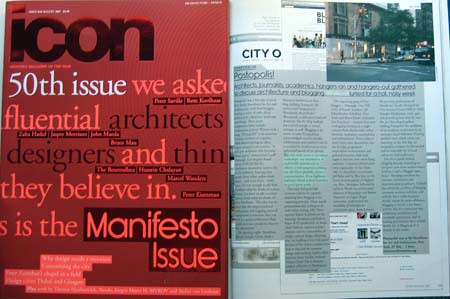
It's like one crazy word: ICON-ON-POSTOPOLIS! I like saying it, what can I say? So I finally got my hands on a copy of the current issue of ICON magazine that includes a sweet review of Postopolis! It’s hard to believe it’s already been three months since we converged at the Storefront in Manhattan, having pulled off one of the most exciting weeks of my life.


Lamenting as I may be, it was a great rush of reminders and recollections to read this piece written by Bill Millard, who did indeed (as the article states) “lurk for a hot, noisy week” – so much so you could have easily mistaken him for an inside organizer of the whole thing. Seriously, Bill didn’t miss a beat, he was on it the entire time with his notepad and sidebar inquiries, and I truly enjoyed talking with you Bill!
Definitely check out the article if you get the chance, it not only captures the essence of the tonality of Postopolis!, for which he writes, “is an assertion: it claims territory to organize, while democratizing an often jargon-plagued conversation,” but also the way it all went down.

“Appropriately, the pivoting perforations of Storefront’s façade brought Manhattan’s noise, grit and punishing heat directly into the pie-slice-shaped gallery, making Postopolis! the anti-thesis of an academic conference in an antiseptic hotel ballroom. Hearing speakers over vehicle noise was daunting the first day, an acceptable nuisance by the second and an enjoyable bit of local colour by mid-conference.”


No question, the Storefront was the perfect place for Postopolis! and any architectural blogosphere’s Woodstock part two will have a tough act to follow in any other location. That said, wherever ‘Blogstock II’ takes place I know you will be there Bill and so I will see you then!

(Oh, and don't miss while you are browsing the mag, which is a landmark 50th issue edition, a mini-manifesto written by Geoff, one of our co-conspirators from BLDGBLOG. And, incidentally, the Storefront is preparing to celebrate its 25th anniversary, so if you are in NYC towards the end of September, go go go! Thanks again Bill!)

Tuesday, May 01, 2007

Postopolis!


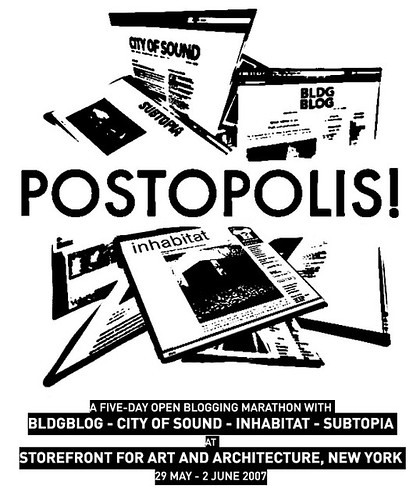
Well, I haven’t had much reason to make too many announcements in the past, but I am very excited to make one today. At the end of May I will be participating in an extremely cool event sponsored by the Storefront for Art and Architecture Gallery in New York City, an awesome venue that has been pushing the boundaries of architectural discourse in the art world for years now. So, for five days, Subtopia, along with three other blogs that I’m sure you are familiar with (and if you aren’t now is the time), BLDGBLOG, City of Sound, and Inhabitat will all come together to occupy and convert this sweet space in Manhattan into our very own public outpost for a week-long blog-a-thon titled Postopolis!

During that time the four of us, Geoff Manaugh (who authors the super fantastic and wildly futurist BLDGBLOG from Los Angeles), Dan Hill (a Londoner who for years now has written City of Sound which was one of the first and coolest urban culture blogs I’ve ever come across), and Jill Fehrenbacher (whom you probably know for having started the immensely popular green-conscious design blog Inhabitat), will go into a complete blogging frenzy while hosting a series of interviews, public discussions, panels, slideshows and other engaging talks with speakers from a wide array of disciplines related to architecture. The goal is to bring the phenomenon of blogging into a live and public domain where we can directly engage with people while also highlighting the impact that bloggers have made in exploring the bounds of architectural conversation.

Check out the official announcement here.


Honestly, I can barely wait for this. Postopolis! will take place from Tuesday, May 29, to Saturday, June 2, with a constant stream of activity. Perhaps even the best part will occur on the last day itself, Saturday, when we invite local architecture bloggers to join us at the gallery to take turns sharing your own blogs with the general public. I know there are many of you out there who are writing about architecture from some really unique angles, and we hope this will be a great opportunity to get everyone together and mingle over a few beers in what must be the first ever mass architectural blog-in.

So, on that note, if you are in or anywhere near New York City, make your plans now to come on down and join us at the Storefront and hang out for a bit. We would love to meet you and hear what you are up to. This should be a furious week of crazy interesting dialogue and good old fashioned fun. If you have any questions, or reason to contact me, don’t hesitate, otherwise be good and spread the word!

I will make further announcements as time draws nearer, but in case you are a new reader of Subtopia, or any of the other blogs that will be featured for that matter, go have a look right now: BLDGBLOG, City of Sound, Inhabitat, and Subtopia - Postopolis!

Wednesday, March 18, 2009

Postopolis! LA Fast Approaching


[Image: POSTOPOLIS! LA. Logo, thanks to Joe Alterio, 2009.]

It’s hard to believe we are only less than two weeks away from Postopolis! LA, and it is really coming together nicely. So here’s a little update.
First, we’ve locked down our location. Looks like we will be hosting the entire event – beginning Thursday, March 31st through Saturday, April 4th from 5-11pm every night – on the rooftop of the Standard Hotel in Downtown LA, which I’m told is quite a spot. I’ve never been but with a pool and bar on top, free wi-fi, projectors, and all of you, only thing I can say is -- sick! I’m not sure we could have done much better -- really psyched about that. So hopefully that alone will entice you to come down and chill with us over some martinis and crazy space conversations on one if not all evenings that week.
Just so you know, Postopolis! is completely free and open to the public. This isn’t a conference, it’s not a lecture series, it’s a more casual weeklong evening of run-on back-to-back short presentations followed by short discussions on a wide array of topics and interests around space design and space production. It’s meant to be a super accessible counter to the conference thing, and on top of the hotel from Happy Hour on every night is gonna be amazing!
Man, I can’t wait. A more formal schedule of speakers will come together soon, but for now here’s a list of who to expect so far.

—Ari Kletzky (Founder, Islands of LA)
—Austin Kelly (Principal, XTEN Architecture)
—Ava Bromberg (Spacemaker, In the Field)
—Ben Cerveny (Strategic and Conceptual Advisor, Stamen Design)
—Benjamin Ball and Gaston Nogues (Architects and Founding Partners, Ball-Nogues Studio)
—Benjamin Bratton (Architect and Theorist)
—Bryan Boyer (Organizer, Helsinki Design Lab 2010)
—Christina Ulke (Artist, Co-Founder, C-Level, and Editor, Journal of Aesthetics and Protest)
—Christopher Hawthorne (Architecture Critic, Los Angeles Times)
—David Burns, Matias Viegener, and Austin Young (Founders, fallen fruit)
—David Gissen (Theorist and Historian, CCA)
—Dwayne Oyler (Architect and Principal, Oyler Wu Collaborative)
—Eric Rodenbeck (Founder, Stamen Design)
—Freya Bardell and Brian Howe (Principals, Greenmeme)
—Fritz Haeg (Artist and Writer)
—Gary Dauphin (Writer and Critic)
—Jeffrey Inaba (Architect and Principal, Inaba Projects)
—Ken Ehrlich (Artist and Writer)
—Mary-Ann Ray (Architect, Writer, and Principal, Studio Works Architects)
—Matthew Coolidge (Director, Center for Land Use Interpretation)
—Michael Dear (Professor of Geography, USC)
—Michael Downing (Deputy Chief of Counter Terrorism, Los Angeles Police Department)
—Mike the Poet (Poet and Writer)
—Orhan Ayyüce (Architect, Blogger, and Senior Editor, Archinect)
—Patrick Keller (Architect and Principal, Fabric)
—Paul Petrunia (Founder, Archinect)
—Robert Miles Kemp (Designer and Principal, Variate Labs)
—Sam Grawe (Editor-in-Chief, Dwell)
—Sharon Johnston and Mark Lee (Architects and Principals, Johnston MarkLee)
—Stephanie Smith (Founder, Ecoshack)
—Steve Roden (Musician and Artist)
—Ted Kane (Architect and Author, Polar Inertia)
—Whitney Sander (Architect and Principal, Sander Architects)
—Yo-Ichiro Hakomori (Architect and Principal, wHY Architecture)

In addition, Saturday, April 4 will be a little different since it will involve a few media panels, including Matt Chaban from the Architect's Newspaper, Dakota Smith from Curbed LA, Greg J. Smith of Serial Consign & Vague Terrain, journalist Alissa Walker, some local Archinect school bloggers, among others you will learn of shortly.
There will be certainly more to announce in the coming days, so just cool your jets. Just in case you forgot – the whole thing is being co-hosted with these badasses: BLDGBLOG, City of Sound, mudd up!, Plataforma Arquitectura/Arch Daily, and we make money not art, all under the organization of the Storefront for Art and Architecture and the sponsorship of ForYourArt.
We are grateful. More in a bit.

Thursday, April 02, 2009

Getting ready for Day 3 of Postopolis! LA


Sorry I haven't relayed this sooner, in case you had known already. Postopolis! is being webcast live both on the Storefront website and For Your Art, so tune in every night at 5pm for live coverage while there's still a bit of light for a few hours. We've set up some lights for when it's gets dark, but it might be a little grainy. The Standard hotel rooftop is an absolute nest, albeit it a bit freezing by sun down, but a brilliant location, nonetheless - gives new meaning to chitter chatter. So, we've also got a Flickr pool going for constant photos, and constant Twitter updates @postopolis, combined with all the others here who are twittering the event the updates have been more or less a fascinating phenomenon in their own right - sort of like mindreading the event, or something.  You can follow my own tweets here @subtopes.
Also, the LA Times mentioned it briefly here. So, we are off an running!  More later. 

Friday, June 08, 2007

Subtopia Meets Lebbeus Woods


It was Thursday, May 31st, sometime after 5:30 PM, essentially, midway through Postopolis! High-noon for our 5-day event, so to speak. All the swivel panels of the Storefront’s façade were wide open and people gathered around the sidewalk to peer through them. It was hot, sticky, the gallery’s dank industrial textures were flaking off, and inside gathered a flock of curiosity with lights and cameras aimed and ready to fire. A supple breeze spread a petrol-infused veil across the air while a stream of delivery trucks groaned over the potholes of Kenmare St. rattling the space’s foundation to its core – almost like some nuanced stream of mini-earthquakes that proceeded his looming wake. In a matter of minutes a bluish pre-twilight tint set the tone inside our SoHo bunker. The gallery reached a buzz it had not until that point – it was at last in full effect.

With chit-chat percolating over the last minute movements of a squirmy gallery scene, he suddenly appeared. Lebbeus Woods, a gregarious man with a deliberate soul to match, stuck out his big old paw and introduced himself. I shook his hand and thought (in one of those absurd little parentheticals that you have about people when first meeting them) that was the hand that held the pencil, probably as light as a bird you wouldn’t want to hurt nor let escape; that was the hand singularly responsible for drawing some of the most incredible renderings I, and a whole generation, had ever seen. Geoff and I smiled and cracked up together seeming to share this thought. Lebbeus is, after all, an architectural legend who has pushed the medium of drawing into the collective imagination perhaps like very few other people have done, that will surely leave an imprint there forever. If drawings could express the ethereal conceptual nature or complex political dimensions of architecture, or, could somehow depict the vast morphologic mystery of the earth’s chaotic crust, then Lebbeus’s work has no doubt achieved an epic, cultish even, stature in its own sheer visual right in this regard.

What follows is a rough transcript of a panel talk between Geoff, Dan, Jill, Lebbeus, and myself at the apex of Postopolis! Nervous, fidgety, anxious to see where it would lead, the four of us were suddenly sitting there passing back and forth a microphone beside the man himself, hurling question after question at him, for which, I must say, he fielded in the coolest of manners.
• • •


Geoff Manaugh: One of the reasons I'm such a fan of your work is because of its ongoing theme of the earthquake, or of terrestrial instability – the idea that the terrestrial referent kind of disappears. Sometimes there might be a building that's not even on the Earth's surface – like Einstein's Tomb – or, there's a kind of a post-earth condition to the architectural structures that you design and in various scenarios that you set up. So I'm wondering if you could discuss that in more detail, and what attracts you to that. How can an architectural structure account for an unstable terrestrial foundation?

Lebbeus Woods: I suppose that my life has been unstable. I was a military brat. I grew up in different places around the U.S.A., always moving from one place to the next. Seriously, that kind of autobiography figures into these things one way or another. But also, I was born in 1940, already in the 21st century, and over those years there’s been tremendous kinds of changes, particularly socially, culturally, and intellectually. I’ve been a witness to all these kinds of changes so there’s a big instability that we have to deal with in our culture. In a sense, the earthquake, or the war are just the most obvious manifestation of it, right? So I think my interest in dealing with instability is an interest in dealing with our condition, our human condition at the present time. I could go on, but we don’t have all that much time so –

Bryan Finoki: My question is, well – I’m sort of interested in your thoughts on the evolution of the political nature of architecture and the political production of space. And I’m wondering, if we’ve come a long way from – or if we’ve come full circle – say, from the times of the Roman Empire and the early inventions of the frontier and notions of borders, to a point now where we are armoring our skyscrapers, and border fences have become a new kind of urban phenomenon. We’ve got these full on detention islands and, so, how – I mean, your book War and Architecture was really interesting, but maybe moving on from those thoughts – I’m wondering, if there’s a different sort of political nature of architecture today, given the ‘War On Terror.’ How would you relate the ‘War On Terror’ and architecture, and how has it shifted the nature of space today?


LW: Well I think architecture as we think of it as a profession and as a practice isn’t very far from the Roman Empire. Still the main thing is to build these monumental buildings, which are kind of valorizing of the hierarchy of power, authority and society. Even if it’s a museum it’s about the elite’s ability to gather works of art and put them in a very special building – maybe a work of art itself. So, I think we are still in that moment, or mentality. Look at the architecture magazines, and so on. That’s the way people think, that’s the way architects think. Not all architects, though.

Fortunately one of the reasons I am out here today are these blogs – your blogs in particular – but, generally, the internet is a place for some other view of architecture to emerge, and therefore it becomes incredibly important. You mentioned security for buildings, or for neighborhoods, gated communities and the rest. Yeah, this is part of the defensive posture architects are forced to enter in to. Rather than having a kind of open and outward moving posture it is about how can we secure these enclaves of power and of wealth. And that’s their job – to beautify it and make it look good, and that making it look good is a major preoccupation.

Dan Hill: This idea of instability or unpredictability and returning to that from a craft perspective, almost, and looking at the professional architecture you describe, we actually have had a lot of talks over the days about the notion of the master builder really dissipating, and architects effectively having to become managers across multiple disciplines, so they're not experts anymore, y'know, they're not acoustic engineers; we have acoustic engineers to do that kind of thing. I am wondering if there is some relationship – I was reading a lecture that you gave about rod-and-cable constructions in Vienna and Paris – you almost created a set of guidelines or rules for constructing things, but you haven't given the details of the implementation. And in a way you're letting the implementation being decided by the people on site, presumably, who may not be architects at all. Does this enable this instability to be configured on site in some way?"

LW: Well that’s the idea. In other words, I think the role of architecture – not all of it, because we’re still going to have the monuments, the big expensive buildings, that’s just the way it’s going to be – but, if there’s going to be another movement, another direction in architecture, it has to engage people differently. Other than saying, here, look at this, isn’t this amazing? It has to interactively involve them other than as spectators, or, as a ‘society of the spectacle.’ It has to engage them as creators.

Now, see, I lived through the sixties when there was a great interest in empowering people in lower economic class communities, right? They were in very bad conditions and architects said, you know, well, let’s go in there and help them improve their conditions. So they went in – it’s called “design advocacy.” I don’t know, you are all so young, and you probably don’t even remember the term, but there were lots of things written in the sixties and early seventies – design advocacy. So, the architect became the advocate of the people in the community. And they’d rent a room, put out a table, a big table – or a lot of tables – then, they’d have meetings with the people in the community with anyone who’d want to come and join us. And provide tracing paper and pens, and help them express their architectural ideas with other people about the community. It was a noble effort but it was a total failure. Why? Because the people in the community couldn’t think in terms of designing. They weren’t educated for that, they just weren’t prepared. So, nothing much ever became of it. There were a few little brick houses that were built, whatever, but it didn’t come out as a real movement in architecture.

Okay, I don’t want to go on too much about this but just to say – my idea is that, 1) you have to engage people, but you also have to give them the tools to work with. You say, the rules of the game. Yeah, you have to give them the rules of the game, like when you play Poker you have to give them the rules of Poker. You can’t just start throwing cards around. So, you give them the basic rules of the game, then you give them some basic techniques: this is how you move this here, and this is how you move that there. You don’t say where you are going to move it. And then, if you’re really starting at a rudimentary level you show them some examples. You say, now it could look like this, or it could look like that, if you follow these rules.

So, this way you are giving people a leg up in the story. And some of the projects I have done in the last four or five years, particularly – although it also traces back to some of the work I did in Sarajevo during the siege of the city in the nineties – these are the things I have been putting out there. Now, whether they will be any better than the design advocacy from the sixties, I don’t know. It hasn’t really gained that kind of momentum, yet. But, being an American I believe people have to choose to do it. I don’t think this is something that should be imposed from the top down. They have to want to do it this way. They have to want to participate.


GM: You have a huge following outside of architecture, in fields like set design, film, and even in comic books. Your work seems to pop up everywhere, throughout the arts, and so I'm wondering if you could address what you see as the appeal of your work. Also, with students you've worked with, and with certain publications you've helped mentor into existence, there are ideas that go beyond architecture – they set up entire situations or scenarios. Things like Arctic research stations, or moving machine cities. All of this seems to capture the imagination of people outside of architecture. So, could you talk about how your own work has that appeal? Especially if there's someone here in the audience who's an architect but who wants to attract a different kind of audience.

LW: Well, I’ll say, first of all, if what you say is true, and I believe to some extent it is, I’m thrilled. I’m thrilled, you know. Although, the irony is, I’ve always addressed my work to architects. I’ve never addressed my work to, you know, to people in the arts or to others, it’s always the architects that I wanted to talk to and say – what can architecture be, let’s look at it and ask, what can it be? And to me, that responsibility is primarily in the hands of architects. There are the ones who say, that’s what I want to do. So, they kind of assume the mantel of responsibility for the field of architects. So, I’ve always talked to architects primarily. It’s kind of ironic that others would pick it up. I’m happy because maybe many of the architects are asleep. [There is a chuckle from the audience.] Maybe, they don’t care. If others do, I’m thrilled. I think I generally approach architecture, in a sense, from a broad way – kind of philosophically, on one side looking at ethics, questions of politics and so on. My whole interest in cybernetics dates back to the late fifties, early sixties. Am I alone with that? So, that’s one side.

The other side is always a visceral kind of gut-feeling that has to work with a visual communication. Because that’s where most of the information in the world goes in, though our eyes – we’re lucky enough to have vision, you know? It has to communicate visually. So, I was working from the philosophical side and the visual side and I try to put those together. I’m still trying to do that. It’s not that I don’t fulfill my own ideal of doing that, far from it. But, if many people can take this into a product realm and get a certain spirit from it, I’m amazed and delighted, if that’s the case.


BF: My next question is kind of about drawing. Actually, one of my favorite pieces of yours is not a drawing at all. It was in Michael Sorkin’s book Against the Wall, which is about the spatial dimensions of the Israeli/Arab conflict. At the very end of the book you propose a border wall game – The Wall Game, I think is was you called it, which I thought was fascinating. [At this point, Lebbeus turns around to me curling his fingers with an A-Okay gesture of approval. We smile, clearly, he is happy I brought this project up.] For those of you that don’t know this piece, or haven’t read it, it’s about this structure, this border wall structure – the security wall that divides the Arabs and Israelis, in fact – that mediates this mutually-created game between them. It sort of demands that one side take away a piece of the wall while on the next turn the other side adds a new piece to it. Simultaneously, adding to and taking away from this border wall as a metaphor for how they are both responsible for constituting and keeping the structure in place, at the same time avoiding this fearful feeling that the wall could at any moment collapse. Taking turns back and forth, putting pieces in and taking them out. It’s a massive balancing act that conjures the thought: what would happen if it did come crashing down? There’s a sense of fear that props this fence up.

So, I’m wondering, a) if you ever did any drawings for that, because, of course, if so I’d love to see them, and, b) if you start with a very definitive context and then go to the drawings and come up with an idea? Or, to what degree you just start drawing and let the context kind of emerge out of that?

LW: Well, it’s kind of a unique piece of work in my body of work over the years. It came about in a really unique way. You’re going to have Michael Sorkin here tomorrow, right? [We quickly explain to him that Sorkin will not be able to join us.] Well, okay. Anyway, I was talking to Michael Sorkin some years ago and he said, I’m going to do this book called Against The Wall with Israeli and Palestinian architects, or, more so, critics and writers. And I said I really wanted to do something with that idea. He said great, great, do it. So, time went by and as I was thinking – I mean, myself, I was completely against the wall – that it was very hard for me, because I felt that anything I did was going to endorse the wall. You know, if I want to put a mural on the wall, or, I want to transform it into housing, almost any other idea is going to actually justify the existence of the wall in some way. So, finally, I realized that the wall had to come down. In thinking about it I imagined it could be an act of creation – a creative act, in the sense of bringing it down creatively, involving both sides somehow, because it is a two-sided conflict. And the idea of a game arose – because we all know it’s just a big game. All of this is just a very serious game. And if it’s just a game in the end we have to understand the rules.

So, I set up the rules in the book. And there are drawings – some very rudimentary drawings, though. Much in the spirit I described a moment ago when I said that I wanted to show some examples to demonstrate rules. And, well, I haven’t gone back to the Israelis or the Palestinians to find out whether or not they want to play this game – they’ve got other things on their minds over there, let’s face it.


DH: You talk about communicating visually, and your drawings are extraordinary, quite impressionistic, which reinforces what you've been saying about your approach (to open-endedness) ... I just got through reading Junichiro Tanizaki's In Praise of Shadows and Juhani Pallasmaa's book The Eyes of the Skin, which is about the senses and how architects deal with other senses, not just sight. And about the dominance of sight within Western architecture ... I wonder, if this, this dominance, devalues for us, smell, sound, taste and so on ... movement, shadows, etc., I wonder, if you've ever explored working with other media for conveying your work other than visually, through drawing. Any involvement in sound or with sound pieces themselves? Or, films and so on?

LW: Not exactly. In the last two or three years I’ve been involved with a few installations. In 2002 in Paris, there was one installation where there was a strong sound component. But you’re absolutely right, though, it’s not my thing. I just haven’t gone there really. Actually, just recently, I thought, maybe I should go back to the idea of making film – a movie. In 1990 when I was working on this film Alien 3, the director called me and asked me to do it, so, I agreed and I worked on it for a few weeks in L.A. and London. And it was an education. He told me at the time, you don’t want to be a designer working in the movie industry, because you are the lowest of the low. And they just take what you do, and they just toss it usually, or, they just change it into something unrecognizable.

You know, architects complain that clients don’t appreciate their work. Movie studios and directors and producers and studio executives could care less about that stuff. So, I did have the fantasy of making a big budget Hollywood movie. I actually wrote a screenplay. I got the famous book by Sid Field, uh… the famous book on screenwriting, I can’t think of the title right now, but a famous How-to based on Robert Towne’s Chinatown, and wrote a script. Anyway, I wrote a screenplay based on my Underground Berlin project, which I did in 1988. The movie is called Underground Berlin. And I, actually (because I made a few contacts in Hollywood at the time), sent the screenplay out to one lawyer/producer friend of mine. He showed it around and said, well, you know, people thinks it’s got some possibility, but it’s going to need a few changes.

In Hollywood you don’t produce a product, you create a process – it’s always about process. So, a screenplay is a process; a film is a process. You can’t look at it as an art. Anyway, these are very intriguing mediums because for me the drawings are about ideas only. They’re not about drawing. I mean if they were about drawing I’d get very bored. It’s about communicating ideas – it’s about finding ideas. Use the drawing to find an idea, and then develop it. You can use the movie in the same way. It can be an incredible medium. If it’s a decent movie we can see how the visual dominates cinema, and whether it presents us with a good vision of the world, or, something to say about this world. But, by and large it’s formulaic. Like buildings, they’re all about the same thing.

GM: You say that all of your work, or most of your work, is directed at architects, but I'm wondering where you turn to when it comes to finding inspiration – when you're looking for a new idea, if you look at architecture but also comic books, films, novels, built spaces, etc. In the process of answering that, I'd like you to address how you incorporate these things into your work as a teacher. I'm interested in how you impart knowledge to a new generation, or to one of your students, and how the educational process works for you.


LW: Okay, there’s two parts. The first part, I can’t honestly say where the inspiration for my work came from. I think it came from reading. It came from texts, from Nietzsche, Schopenhauer, it came from, you know, Jean-Paul Sartre. These are the ideas that got me worked up and inspired. It wasn’t so much the visual things that inspired me. Although, of course, there were plenty of painters in history that I admired all the way from Brueghel to Goya, to Picasso – because everything visual stimulates me. So, there’s so much stimulation there that I can’t point to any one thing being a sort of origin. I mean – texts and writing, points of view, ways of looking at the world – this is what I found along the way, I think, and, ultimately what decided what I chose to do.

Now as far as education, you know, teachers are sometimes the prisoners of their school. But I’ve been very lucky, I’ve taught at Cooper Union for, well, going on twenty years, off and on – mostly on. And I have had two deans that I’ve worked with both down here, John Hejduk and now Anthony Vidler, who have more or less given me my latitude. I’ve taken the opportunity to try and work with students the way I would work with any people. I mean students are just people, aren’t they? [We all laugh at the simple truth of this, and perhaps the refreshing tone of such a statement.] I think. And, I almost hate the term student, alright? But, I understand that it has a particular meaning. So, if I were working with a group of people who are making an installation project I would work with them exactly the same way I’d work with the students. So, I set out a question, lay out some rules, and we get to work and develop modes of answering the question. I believe the most important thing a teacher does is ask the right question. If the teacher asks the wrong question, or a question that everyone already knows the answer to, then you can’t learn anything. You have to ask questions that you don’t even know the answer to yourself, and together you work towards it. To me that’s education.

BF: And I think that’s the essence of architecture, too. It has to ask questions, pose challenges – it has to be willing to push through experimentation rather than always just be willing to fall in line and do what we’re told – of being a practitioner, or merely providing a service. I’m also curious what you are working on today, what sorts of things excites you at the moment? What projects have you got cooking, or, where will you set your sights next? Or, what may be your future plans for the institute, or, even, what your plans are right now? Could you talk about that?

LW: Well, that’s hard. I’ve always worked, more or less – except in certain moments – alone. I’ve got an office. I have collaborators from time to time that I work very closely with. Basically, I sit down, usually sitting – although, recently I’ve been doing some pretty large drawings where I have to stand up on a ladder – but, I basically work alone. I spend a lot of time thinking. Not necessarily doing anything. I don’t feel like I have to do some product necessarily. I think a lot. I read. I draw. And the ideas that interest me now, I don’t know – there are several.


I’ve always been interested, I think – if you look back at my work from the beginning, really – I’ve always been interested in the idea of the artificial landscape. Reforming the landscape. Architecture being a method of reforming the earth’s surface. We reshape the earth’s surface, from architecture to paving streets, to parking lots and buildings that are really reforming the surface of the earth. Reforming nature, taking over what we find. And we’re mushing it around and remaking a new earth – or, what we used to call Terra Nova. So, that’s what I’m thinking about, that’s what I’m still doing. Still making drawings in that direction. Less and less they’ve become populated by any kind of buildings. I haven’t worked on any building-like structures for quite a while.


There was a project in Vienna in 2005, it’s called “System Wien” – I happen to have my collaborator here, Christoph Kumpusch – and we’re really investigating architecture as energy, as the accumulation of energy, as the materialization of energy, and try to look at architecture and the making of space that way rather than enclosure, and so forth. So, we don’t look at the vectors and shifting vectors, contours, limitless boundaries of space. It’s an investigation that I am still carrying on today, primarily in drawing and some writing.

Now, socially, there is a dimension to that, and something I think we are all going to have to deal with, eventually. And architects better start dealing with it – that is the notion of slums. You know, Mike Davis wrote an amazing book and he kind of called everyone’s attention to it but, they’re out there, and we’ve all been aware of them. I was certainly aware when I went to Brazil in 1987 and saw the favelas in São Paulo, Brazil. I was shocked and even wrote about it in one of my earlier books, but this is nothing new. It’s just that I’m beginning to feel I better start while I’ve still got life left in me – that I better start turning some of my attention to this critical problem. Because it’s really an architectural problem.

The main thing is that the living environment is desperate – the living environment is awful. It’s oppressive, and that’s what we architects do: is deal with the living environment. So, it kind of makes sense that we should be looking at how to solve the problem. So, I have some ideas. It’s a little preliminary to say, but it’s along this line – that if we can do something from the outside, for them who are inside the slum, it’s going to be to empower them somehow; to transform the slum from the inside. You’ve got to figure some methods to empower people in the slum to change their own environment. It can’t be us airlifting in ready-made solutions. That’s what I think.

BF: I’d like to respond to that actually. I’ve been thinking about the slums too and have been through a few myself. But for me, as interesting as what architects can do from the outside is to look at what’s already being done by themselves, and maybe architecture can approach enablement that way – by not necessarily bringing something in from the outside but, more or less, working with them to help translate what they are already improvising on their own. Potentially, squatters have already become the future architects of the world given the particular innovation that’s going on there and the survival mechanisms of that. It’s certainly an interesting relationship. I agree that architects have to learn how to intersect and get involved but I also think there is a lesson there to be learned from them, too.

LW: Oh yeah, that’s where we have to look. [Switching gears, letting us know he is readying himself to leave, Lebbeus hints at the fact that we are running out of time.] That’s where it has to go. I mean, it can turn up in books and publications and so forth, but, I think the internet – and what you guys are doing – is so incredibly creative and powerful, and alive, that I want to be part of it. That’s why I am here today and I appreciate the opportunity. So thank you.

• • •

And just like that, the dialogue was over. But, was it? It seems like the themes and ideas Lebbeus is talking about can’t help but to evolve, perhaps more so outside the field of architecture, because his work is about the process of evolution itself and not the mere products that are the result of it. And, sensing that perhaps architecture’s real future lies to some degree on this periphery, his enthusiasm for the prospect of a new movement is intrepid and unbound, and ultimately comes from a sense of raw curiosity that is primarily human before architect.

Lebbeus is quite obviously motivated by the exchange of ideas even more so than their representation, and as much as his results are in the end usually a drawing, it is about fostering some form of growth, forging some new landscape of architectural introspection. This artistic type of self-awareness was evident in our conversation and was incredibly down to earth, engaging on an extremely rooted level; cogent, embodying the kind of visionary antithesis of what architecture has become to symbolize today. Without romanticizing his work, I wonder how the two will continue to emerge – the exceptionally conceptual and the devoted advocate type of architecture – is it that collaboration that will in some sense maybe even save architecture from itself? I don’t know. Lebbeus’ conversation was refreshing and for that I want to sincerely thank him for joining us.


[Finally, in case you missed it, Dan also wrote up a great review of this discussion with his own thoughts and reflections, not to mention the miraculous coverage he has provided of the whole event. Check it out if you crave even more. And, evenif you don't! And a majority of the photographs were taken by Quilian Rilano, while others have been lifted from the pool. The artwork is obviously courtesy of Lebbeus Woods.]